
The KT Tape Course
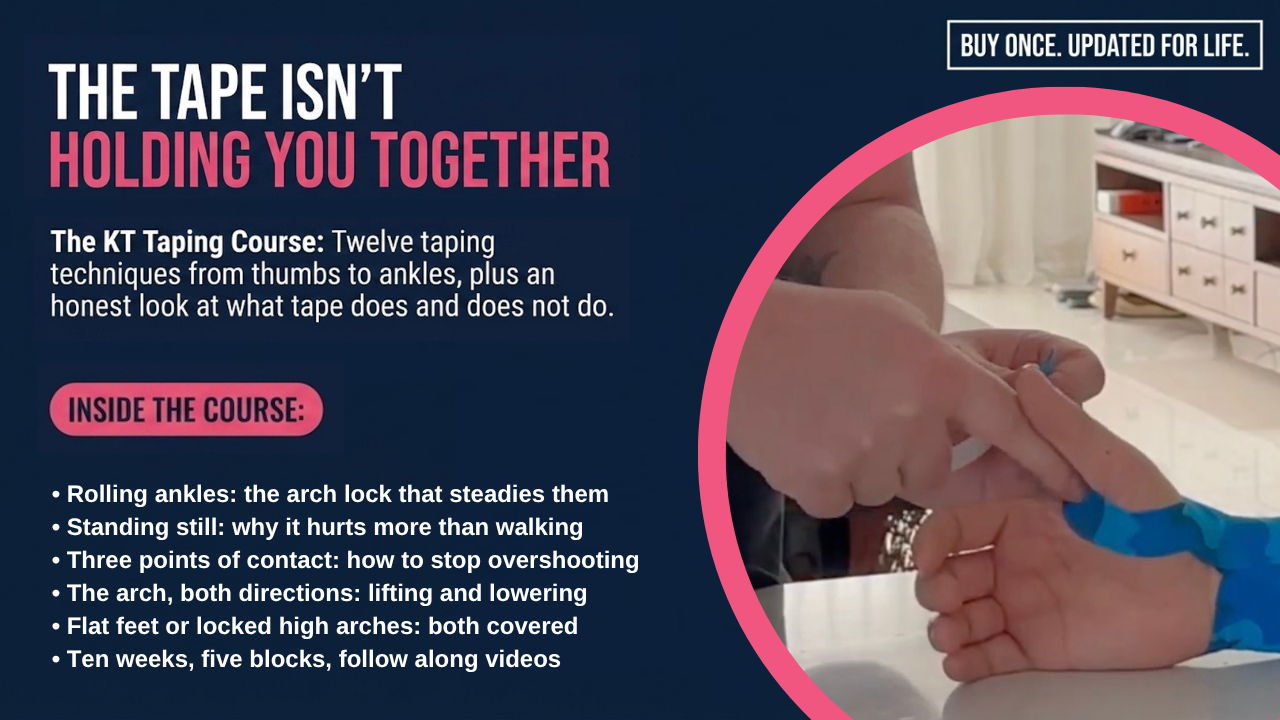
This is an educational course introducing how kinesiology tape is commonly used as a support strategy in movement and training contexts.
The course focuses on explaining the principles behind KT taping and demonstrating how tape is applied to different areas of the body. The emphasis is on understanding taping as a way of providing external sensory input and support during movement, rather than as a standalone solution.
All applications are presented as examples, allowing you to explore how taping is used in practice.
What this course covers
This course introduces:
• The basic principles behind kinesiology taping
• How tape is commonly applied to different joints and regions
• The role of tactile and sensory input in movement contexts
• How taping is used alongside movement rather than instead of it
The aim is to help you understand taping clearly and apply it confidently as a support option when exploring movement.
What you will learn
Educational content explaining how external tactile input is discussed in relation to movement awareness and coordination.
Support without rigid restriction
Demonstrations showing how tape is applied in ways that allow movement to continue, rather than immobilising joints.
Step by step taping demonstrations
Clear, follow along tutorials showing how tape is applied to commonly taped areas of the body, with explanations throughout.
What’s inside
Thirteen lessons across four modules.
Module 1: Introduction to KT Taping
What kinesiology tape is and what it does, then the practical part that usually gets skipped. Skin preparation, cutting a strip, and handling the tape so it stays where you put it.
Module 2: Upper Body
Six applications demonstrated start to finish. Thumb, fingers, wrists, elbows, shoulders and neck.
Module 3: Core
Ribs, hips and SI joints, with the tape applied so the area can still move.
Module 4: Lower Body
Knees and ankles, applied so you can still walk, stand and load the joint normally.
Who this course may be suited to
This course may be of interest to people who want to learn how kinesiology tape is commonly used as a support strategy during movement.
It may also be useful for coaches, trainers and practitioners who want a clear, practical overview of taping principles and applications.
Course format
• Thirteen lessons across four modules
• Step by step taping demonstrations
• Work through it at your own pace
• Lifetime access