
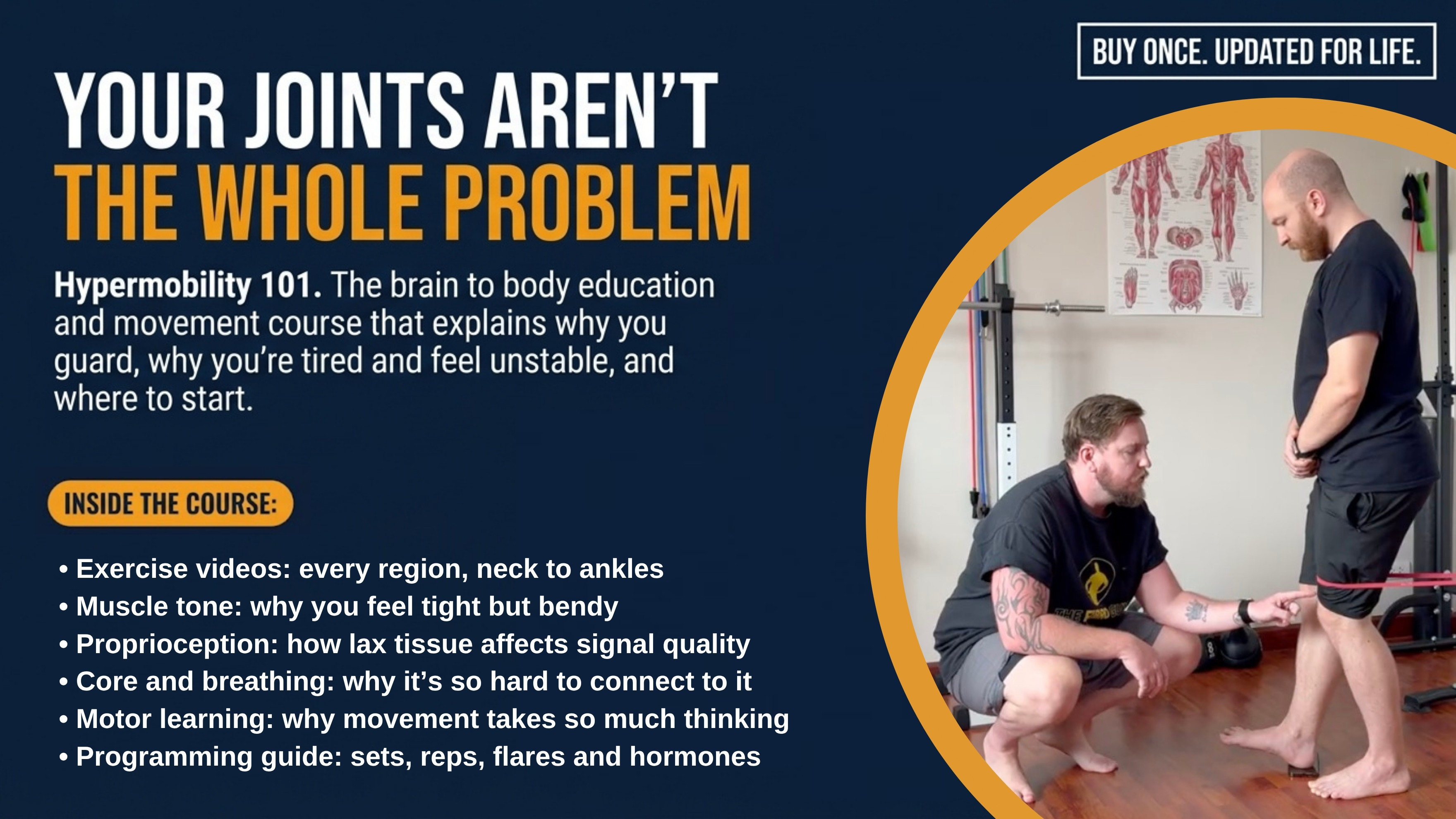
Hypermobility 101
You have probably been told to strengthen. To brace. To stabilise.
And maybe some of it helped for a while. But the instability comes back. The fatigue comes back. The feeling that your body is working against you comes back. And no one has ever really explained why.
The issue with hypermobility is not purely structural. It is not just that your joints are lax. The nervous system is involved, specifically the way your brain builds and maintains its internal map of your body. When that map is imprecise, stability becomes unreliable regardless of how much you have strengthened.
Most rehab for hypermobility skips this entirely. It goes straight to exercises without ever addressing the sensory clarity that makes those exercises actually work. That is the gap this course fills.
THIS COURSE IS DIFFERENT BECAUSE...
Hypermobility 101 teaches the neurological framework behind joint stability, the part that most physiotherapy, gym programmes, and online advice never address. You will understand what cortical maps are, why they matter for hypermobility, and how to use tactile cues to start retraining the system from the ground up.
WHAT YOU WILL UNDERSTAND AND BE ABLE TO DO
- Understand what cortical maps are and why they become imprecise in hypermobility
- Understand the difference between muscle tone types and why "just getting stronger" is only part of the picture
- Apply tactile cue techniques to your own body and understand why they work
- Build a personal movement plan using the principles from the course
- Have a framework for understanding why some movements feel stable and others do not
WHO THIS IS FOR
- People with hypermobility (diagnosed or undiagnosed) who feel let down by generic advice
- People who have tried exercise, but feel like something was missing from the explanation
- People who feel unstable despite being told their scan is "normal"
- People who want to understand the why before doing the exercises
WHAT IS INCLUDED
Intro: Understanding Your Maps
How your brain builds its internal map of your body, what cortical maps are, why they become imprecise in hypermobility, and why that matters more than joint laxity alone.
Unit 1: Sensory Mapping and Tactile Cues
How to break the subluxation cycle by improving the quality of the sensory signal going into your brain. You'll learn what tactile cues are, why they work, and how to apply them to your own body.
Unit 2: Motor Patterning and Muscle Tone
Why your muscles brace, what muscle tone actually means in hypermobility, and how to start changing the way your nervous system organises movement using time-under-tension and tactile input.
Unit 3: Full Body Exercises
Follow-along video sessions covering ankles, knees, hips, core, ribs, shoulders, and neck. Every exercise is demonstrated and explained.
Unit 4: Building Your Own Plan
Beginner and advanced programming tables with sets, reps, and video links for every exercise. Upper/lower split. You leave this unit with a personalised plan you can start immediately.
Also included:
-
Equipment list (one resistance band and a door anchor, that's it)
-
Lifetime access, work at your own pace
-
Leads directly into Hypermobility 102 when you're ready
Start understanding your system.
Or take three courses together
For less than buying them individually.
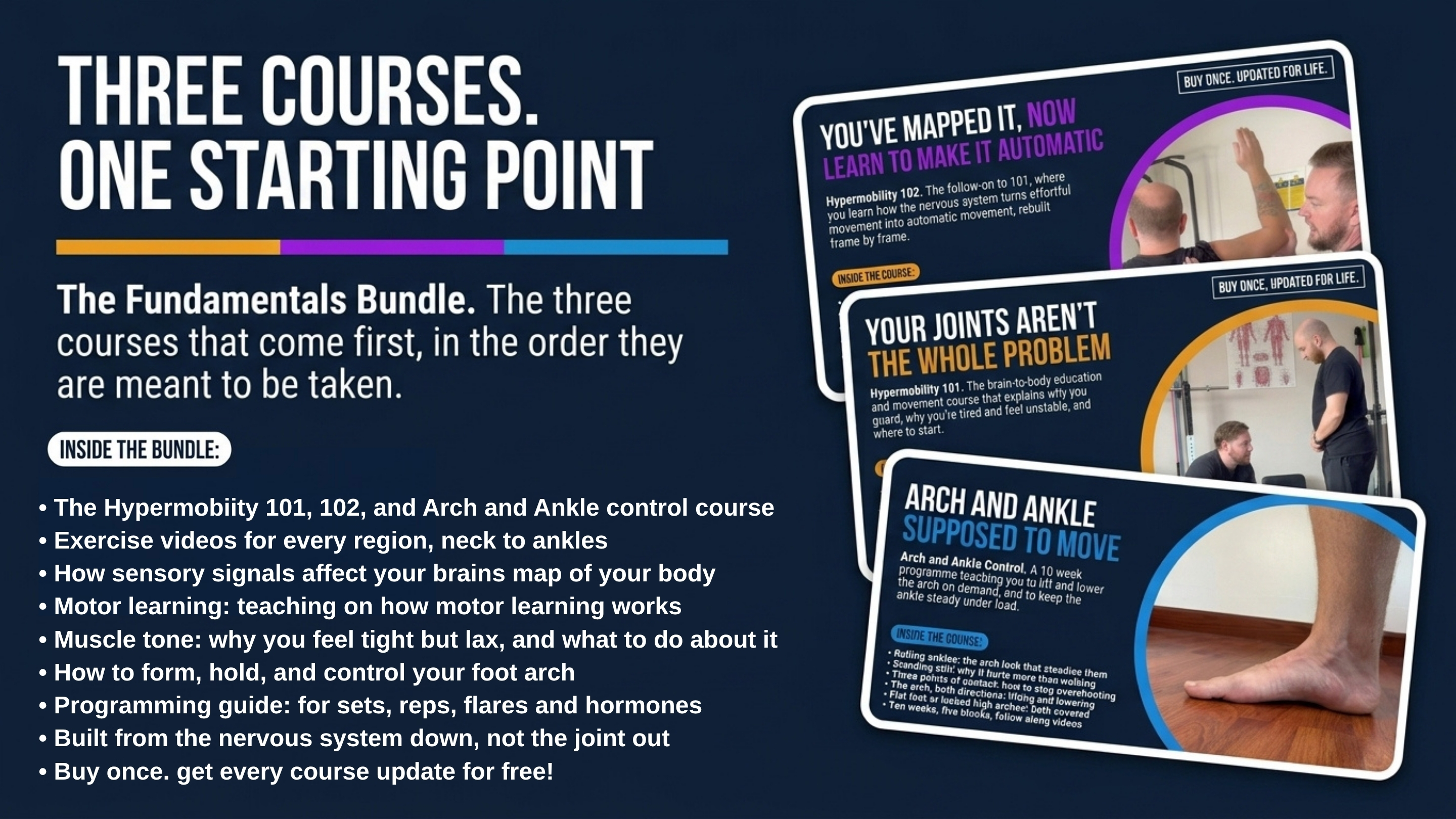
The Hypermobility Fundamentals Bundle
Rehab works like a draft. You get the basics down first, then go deeper, and ignoring that order is why most hypermobility programmes stall. Laxer tissue gives the brain a less precise signal about where a joint is, so control has to be built and then rebuilt at a higher level before load is piled on. These three courses run in that sequence. Hypermobility 101 gives you the model, the foundations and how to programme for a hypermobile body. Arch and Ankle Control applies it at the foot, because the foot is the first thing the ground talks to. Hypermobility 102 goes deeper into contralateral coordination and motor learning, how a movement becomes automatic, and the drills and templates that get you there.
£149.99 GBP
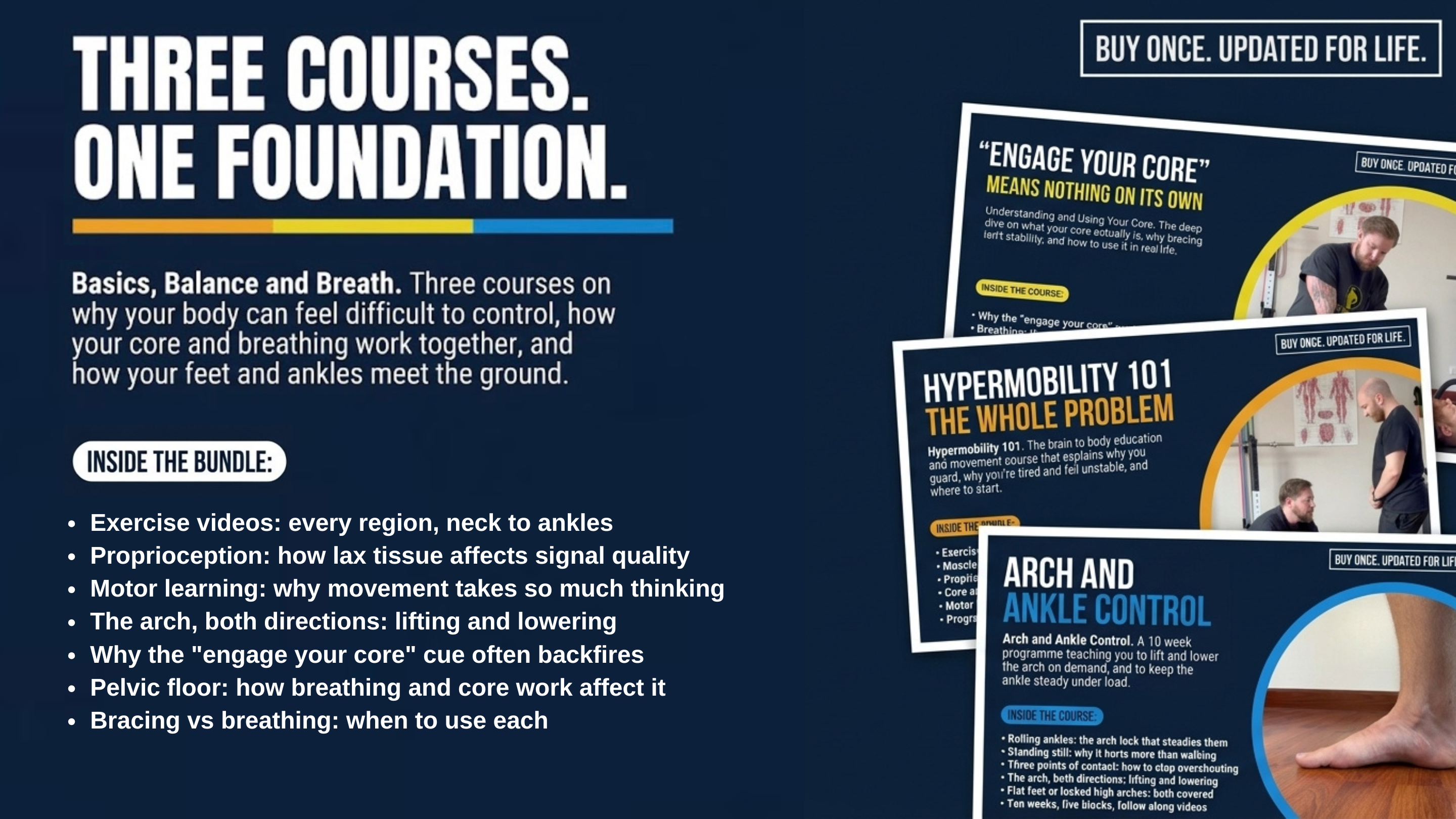
The Basics, Balance and Breath Bundle
Hypermobility is not one problem in one joint, it is a system that is harder to read. Laxer tissue gives the brain a less precise signal about where a joint is, so the brain hedges. It stiffens what should move, leaves loose what should hold, and the trouble turns up wherever the load lands that month. These three courses work the places that change the most for the least effort. Hypermobility 101 gives you the model, what is happening and how to train control rather than chase flexibility. Arch and Ankle Control applies it at the foot, the first thing the ground talks to. Understanding and Using Your Core treats the middle as a pressure system your breathing supports or fights, not abdominals to tighten.
£129.99 GBP
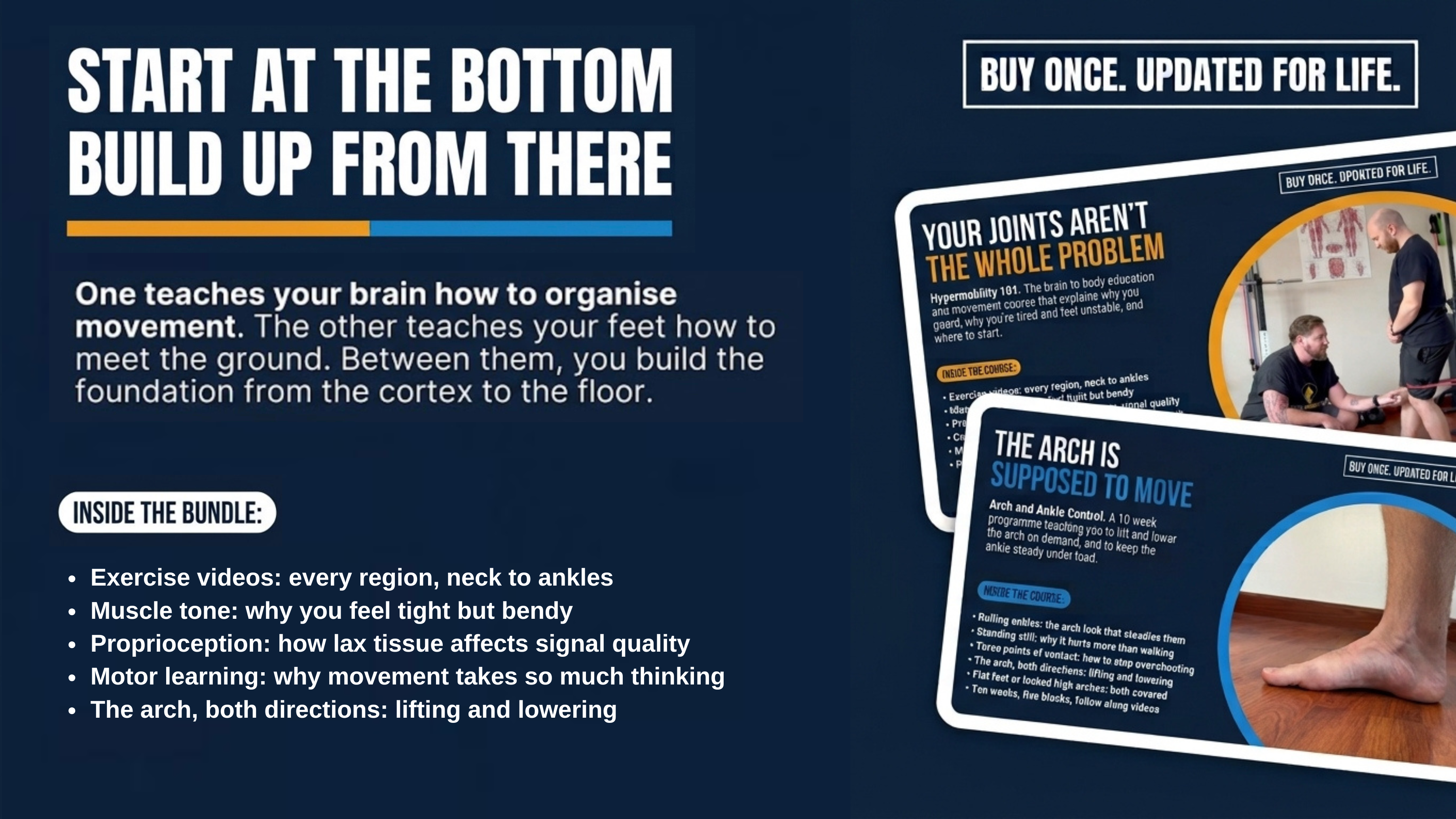
The Hypermobile Beginner Bundle
Most people with hypermobility are handed a sheet of strengthening exercises and told to get on with it. It rarely holds, because the problem was never purely strength. Laxer tissue gives the brain a less precise signal about where a joint is, and no amount of strength organises a joint the brain cannot locate. These two courses deal with that, in the order that makes sense. Hypermobility 101 gives you the model: what is actually happening, why your joints behave the way they do, and how to train control rather than chase flexibility. Arch and Ankle Control applies that model at the foot, because the foot is the first thing the ground talks to, and when its signal is poor everything above it compensates.