The Next step: Hypermobility 102
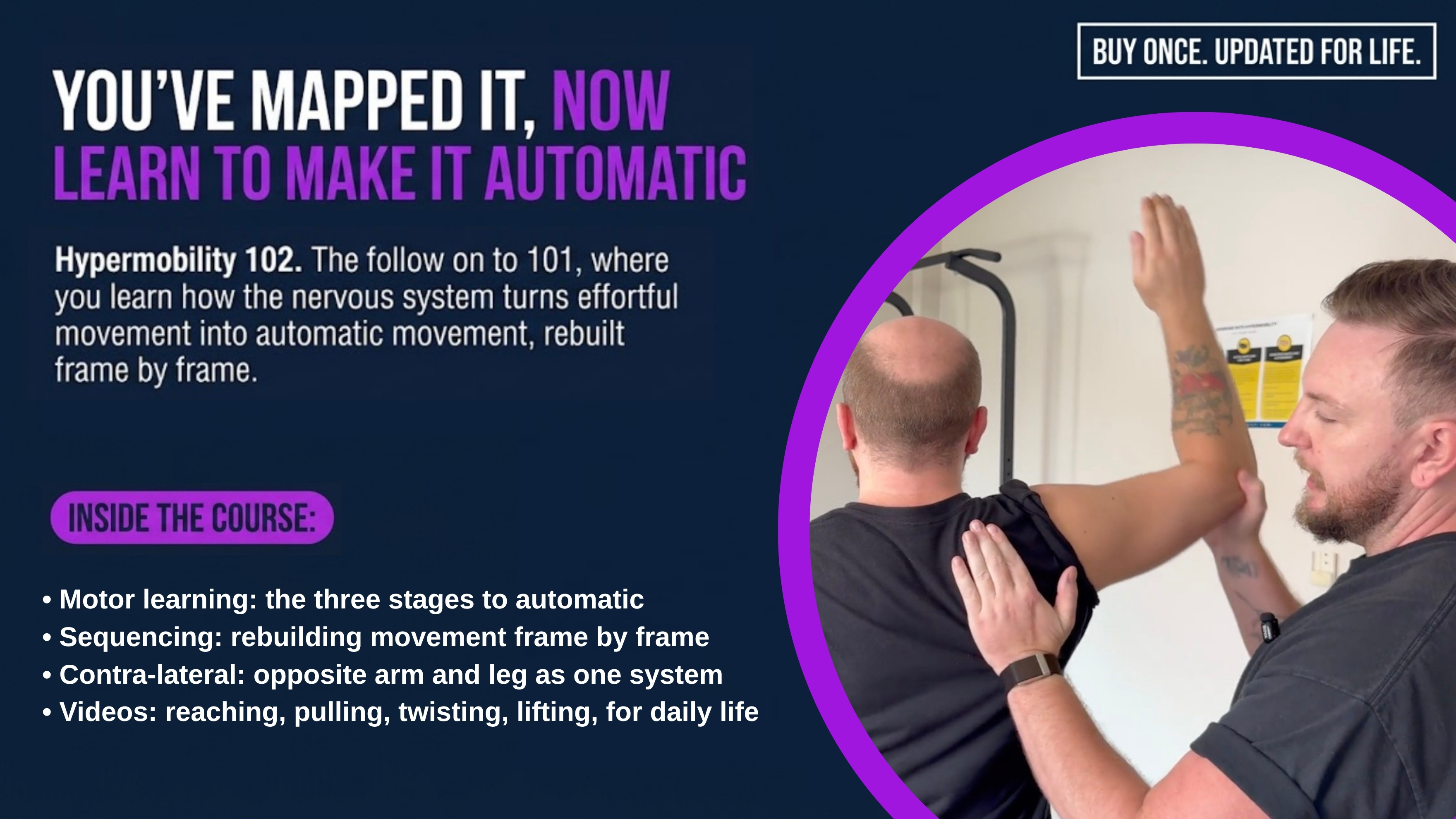
Hypermobility 102 is a direct continuation of Hypermobility 101. It assumes familiarity with concepts such as proprioception, cortical maps, muscle tone, and tactile input, and builds on them to address a core problem in hypermobility
how stable movement is actually learned and retained over time.
This course focuses on how the nervous system uses sensory input to organise joint position, coordinate movement, and develop repeatable stability patterns. Rather than relying on constant conscious control, the aim is to understand how movement becomes more organised, reliable, and automatic through learning.
Education is paired with structured, follow along movement sessions to show how these principles are applied in practice, not just discussed in theory.
What this course is about
This course teaches motor learning in depth, with a specific focus on how the brain learns, refines, and recalls movement and stability.
You will work through the three stage motor learning model and learn how movement typically progresses through:
• An early stage focused on understanding, exploration, and sensory feedback
• A refinement stage focused on consistency, timing, and coordination
• A later stage focused on integration, efficiency, and more automatic control
These stages are explained clearly and then demonstrated through movement, showing how stability and coordination are built through practice rather than overthinking.
This framework is particularly relevant for people who feel they have to consciously monitor every part of their movement to stay controlled.
How movement is trained in this course
Movement sessions in Hypermobility 102 are designed to show how sensory input, coordination, and sequencing drive motor learning.
You will work through structured follow along sessions that demonstrate:
• How sensory input influences joint position sense during movement
• How movement sequencing improves control and clarity
• How stability patterns are built through repetition and task design
• How contralateral movements link opposite sides of the body
• How cross body coordination supports real world movement tasks
Visual and attentional elements are introduced to show how perception, attention, and movement interact during learning.
Inside the course
The course is organised into structured sections that align with motor learning principles.
Inside, you will find:
Each section builds on the previous one, reinforcing concepts from Hypermobility 101 and extending them into more complex, integrated movement.
Module 1: Janky Movement
Why movement in hypermobility often feels awkward, jerky, or effortful. What's actually happening in the nervous system when movement doesn't flow, and how to start training around it. Includes the arch control pattern.
Module 2: Sequencing and Motor Learning
The three-stage motor learning model explained and applied. How movement progresses from effortful and conscious to smooth and automatic. Six follow-along movement patterns: reaching, contralateral pulling, contralateral extension, sitting and twisting, leg lifts, and picking things up from the floor.
Module 3: Contralateral Movement
How opposite-limb coordination builds real stability through diagonal sling systems. Three follow-along exercises that train the body to link opposite sides during movement, the way it needs to work in daily life.
Module 4: Visual-Motor Integration
How watching your own movement (mirror and video) accelerates the learning process by matching what you see with what you feel. Practical methods for integrating this into your sessions.
Also included:
-
Equipment list (tubular resistance bands with handles + door anchor)
-
3-phase programming guide (blocked, mixed, interleaved) with sample weekly schedules
-
Lifetime access, self-paced
Each section builds on the previous one, reinforcing concepts introduced in Hypermobility 101 and extending them into more complex and integrated movement tasks.
How the material is presented
This is a follow along movement and education course designed to be practised, not just watched.
Throughout the course, you will:
• Watch teaching segments explaining how motor learning works
• Follow structured movement sessions designed around learning stages
• Observe how changes in sensory input influence movement organisation
• Practise movements repeatedly to see how control develops over time
The course is self paced, with the option to revisit and repeat sections as needed.
Who this course is for
This course is for people who have completed Hypermobility 101 and want to understand how stable movement is built, refined, and maintained.
It is particularly relevant for people who struggle with over controlling movement, feel mentally fatigued by constantly thinking about technique, or want a clearer framework for how coordination and stability actually develop. It is also suitable for coaches and practitioners who want a practical motor learning framework for teaching sequencing and contralateral movement.
Course format
• Follow on movement and education course
• Builds directly on Hypermobility 101
• Structured teaching paired with follow along movement
• Focus on motor learning, sequencing, and coordination
• Lifetime access to course materials
