
Understanding and Using Your Core
What your core actually is, why bracing is not stability, and how to use it without thinking about it. The full course, built for hypermobile bodies.
Get Instant Access Now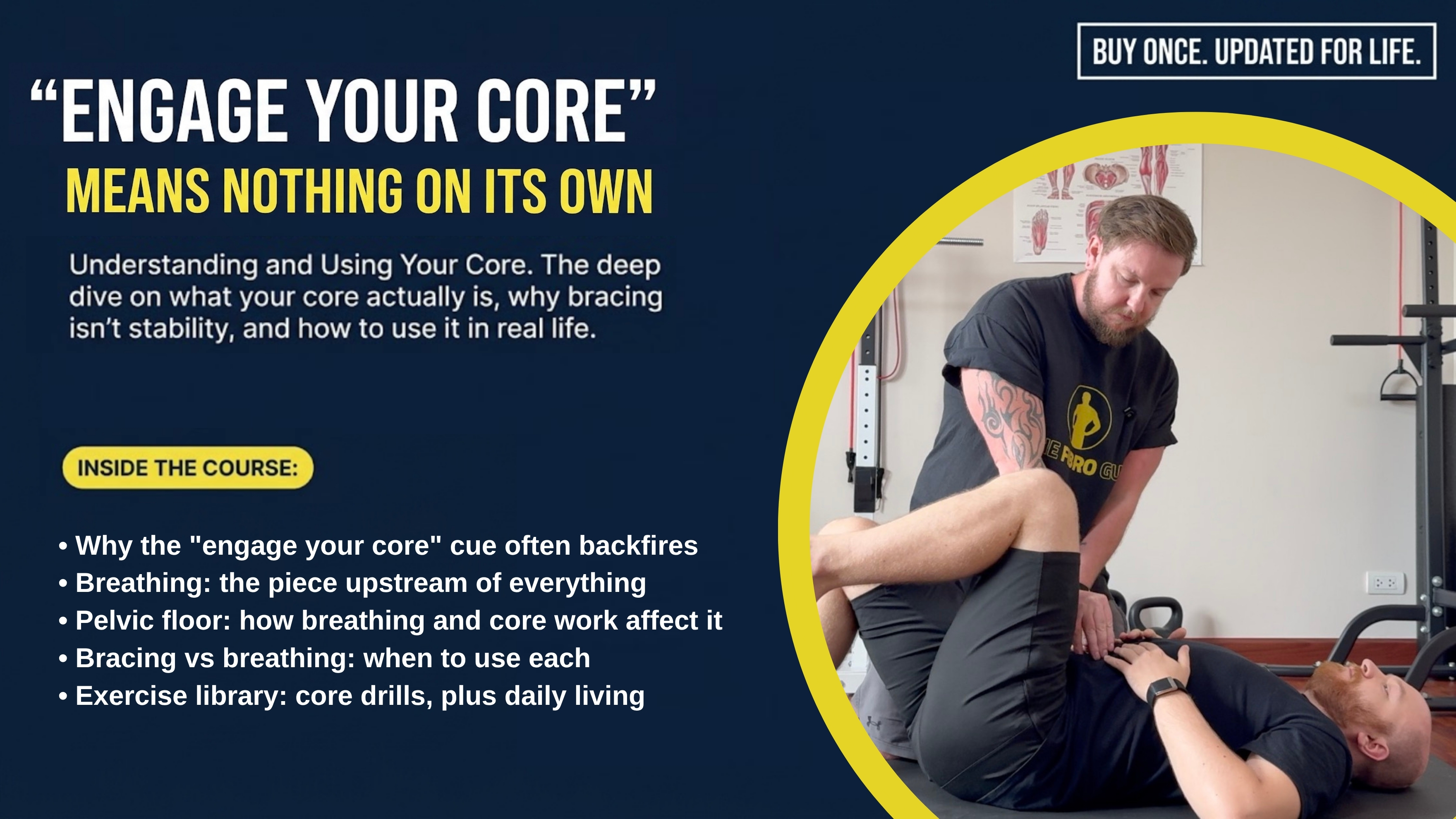
You have been told to engage your core, and nobody has ever explained what that actually means.
So you brace. You hold your stomach in through the day, you tense before you lift, and the back pain or the SI pain still turns up on schedule.
Your core is not your abs, and it is not one muscle you switch on. It is a cylinder. The diaphragm across the top, the pelvic floor across the bottom, the deep abdominal and back muscles around the sides, and your breath running through the middle of all of it. When that cylinder is coordinated you get stability you never have to think about. When it is not, bracing is the only tool you have left, and nobody can brace all day.
This is why more core strength keeps not working. Strength is rarely the missing piece. Timing is. A system that fires a fraction late, or fires everything at once because it cannot tell which part to use, feels unstable no matter how many planks you have done, and doing more planks does not teach it to time anything.
For those with hypermobility this matters more than it does for most people. More compliant tissue means the joints lean harder on muscular control, and harder still on the quality of the information reaching the brain from those joints. A high tone pelvic floor gets read as a weak one, Kegels get handed out, and things get worse. Breathing gets flagged as the answer, then taught badly, and the guarding gets worse too.
THIS COURSE IS DIFFERENT BECAUSE...
The education comes first and the exercises come last, on purpose. Three modules of understanding before a single rep. You learn what the cylinder is, why the cue to brace backfires, what the pelvic floor is actually doing, and why the breath is the thing that drives the whole system. Then, once that makes sense, you get the exercise library, with a video for every movement and beginner, intermediate and advanced tables to work from.
It expands the core section from inside Hypermobility 101 into the full thing. If you have done 101 you will recognise where this starts. If you have not, nothing here depends on it.
WHAT YOU WILL UNDERSTAND AND BE ABLE TO DO
- What your core actually is, and why the cylinder matters far more than the abs
- Why the "engage your core" cue backfires so often, and what to do in place of it
- The difference between bracing and breathing, and when each one is the right tool
- Why a high tone pelvic floor is not a weak one, and why Kegels can make it worse
- How the SI joint borrows its stability from the slings that cross it rather than making its own
- What carbon dioxide tolerance has to do with how you breathe, and how to test your own
- Run a full core practice, from dead bug regressions through to one handed farmer's walks, with sets and reps set out for you
- Carry all of it into ordinary days, which is the only place it ever counts
WHO THIS IS FOR
- Those with hypermobility, hEDS or HSD who have been handed core work that never quite landed
- Anyone who took Hypermobility 101 and wants the core section opened right up
- Anyone holding their stomach in all day and calling it stability
- People who want to understand what they are doing before they do it
WHAT IS INCLUDED
Module 1: What Your Core Actually Is
The cylinder, piece by piece. Why the core is not the abs, where the "weak core" idea came from and why it holds so many people up, and what the deep system is genuinely doing while you are stood still.
Module 2: Why "Engage Your Core" Goes Wrong
Guarding, and how a protective strategy quietly becomes your only strategy. What false stability feels like from the inside. And the pelvic floor, including why high tone gets mistaken for weakness and why Kegels so often make it worse.
Module 3: Breathing
Why the breath comes before the exercises, why "just breathe deeply" backfires, and how the breath works as a nervous system tool rather than a relaxation gimmick. Then the carbon dioxide piece almost nobody explains, what the science actually says, and an overview of pooling.
Module 3.7: CO2 Pooling Techniques
A full practical section. The Body Oxygen Level Test so you have your own starting number, guided intros to the CPA and TB sessions, a downloadable schedule, an advanced technique when you are ready for it, and a lesson on exactly when to stop.
Module 4: The Core Exercise Library
Every exercise demonstrated and explained. Connecting to your core, dead bug base regressions, reverse crunches, side bends, oblique steppers and the one handed farmer's walk, plus a word on daily living, because a core that only works on a mat is not much use to you.
And then: Putting It All Together
Beginner, intermediate and advanced tables with sets, reps and a video link on every row. Before any of the numbers, the instruction we care about most, which is to spend a week or two just practising the movements until your brain knows what it is doing. Then the numbers make sense.
Also included:
- 23 lessons across 4 modules, all video led
- Lifetime access, worked at your own pace
- Every future update to the course, at no extra cost
- Sits alongside Hypermobility 101, and stands up perfectly well on its own
Stop bracing. Start understanding.
Start with the core
Understanding and Using Your Core is £40, paid once, and it is yours for life.
No subscription, no upsell at the end, and every update to the course lands in your library without you paying again.
Get Instant Access NowWhat this course is not
It is not a treatment, and it is not medical care. It is education, and it does not replace anything your doctor or your physio is doing with you.
It is not a quick programme. If what you want is a six week plan with a before and after photo at the end, this is the wrong thing to buy, and we would rather tell you that now than take your forty pounds.
And it is not about abs. Nobody here is chasing a flat stomach. The aim is better breathing mechanics and core stability that runs on its own, so you can stop consciously holding yourself together for the rest of the day.
The alternative is another year of bracing, another set of exercises handed over with no explanation attached, and the same back and pelvis conversation next winter. You have already done that year. It is worth understanding the system instead.